Physician Burnout vs Moral Injury: Why “Just Take a Break” Makes It Worse

Dark compressed structure beside an open stone pavilion connected by a glass passage, representing institutional burden and a repaired clinical pathway.
Physician distress is often described with one word: burnout. That term remains useful, but it does not explain every form of suffering in clinical work.
A physician may be exhausted by chronic occupational stress. Another may be distressed because repeated administrative barriers prevent appropriate patient care. Many experience both. The distinction matters because the mechanism determines the intervention.
A vacation can restore some capacity. It cannot repair unsafe staffing, conflicting incentives, loss of clinical autonomy, or repeated violations of professional values.
Burnout and moral injury describe different mechanisms
Burnout is an occupational phenomenon associated with chronic workplace stress that has not been successfully managed. It is commonly described through three dimensions:
Exhaustion, including depleted physical and emotional capacity
Mental distance, cynicism, or detachment from work
Reduced professional efficacy, including diminished confidence in effectiveness
The World Health Organization classifies burnout as an occupational phenomenon rather than a standalone medical diagnosis. It is also not a synonym for depression, anxiety, or another psychiatric disorder.
Moral injury describes a different pattern. In health care, it can arise when a clinician knows what care a patient needs but is repeatedly prevented from providing it because of external constraints. Dean and colleagues describe this as a conflict between professional moral commitments and institutional conditions that make those commitments difficult or impossible to uphold.
Potential contributors include:
Unsafe staffing or inadequate clinical resources
Administrative barriers to necessary treatment
Productivity pressure that limits meaningful patient communication
Repeated premature discharges
Policies that prioritize financial or operational metrics over patient needs
Loss of professional autonomy
Punitive responses to ethically complex situations
Persistent exposure to care decisions that violate clinical judgment
Moral injury is not a standalone psychiatric diagnosis. Not every distressed physician has moral injury. The term identifies a morally injurious experience or pattern of distress, not a diagnostic category.
The two mechanisms can overlap. Chronic moral conflict can increase occupational stress, while exhaustion can reduce the cognitive and emotional capacity needed to process ethical conflict. The result may be a combined pattern of moral injury burnout, with depletion, cynicism, guilt, anger, and loss of meaning occurring together.
Why “just take a break” misses the problem
Time away from work can be clinically useful. Sleep, recovery, medical evaluation, and separation from acute demands may reduce physiological strain and restore short-term capacity.
The limitation is simple: a break changes the physician’s exposure to the system. It does not necessarily change the system.
For burnout, leave may reduce exhaustion while the underlying workload, documentation burden, staffing model, or leadership problem remains. The physician returns to the same configuration, and symptoms may recur.
For moral injury, the mismatch is even more direct. Rest does not resolve the fact that the physician is being asked to act against professional judgment or tolerate conditions that compromise patient care. If the return environment is unchanged, the contrast between temporary relief and recurring ethical conflict may intensify frustration.
“Just take a break” can also create an unintended message: the problem is located inside the physician. That framing may increase shame and make a systems-level problem appear to be a personal failure of resilience.
A break can be part of recovery.
It is not a substitute for structural correction.
The organizational evidence is stronger than the individual-only approach
The evidence does not support treating physician burnout as an individual weakness.
In a systematic review and meta-analysis of controlled interventions, Panagioti and colleagues found that organization-directed interventions produced a larger reduction in burnout than physician-directed interventions. The pooled effect was approximately 0.45 standard deviations for organization-directed interventions, compared with approximately 0.18 standard deviations for physician-directed interventions.[1]
West and colleagues also found that interventions can reduce physician burnout, with benefits from both individual and organizational approaches. The overall effects were modest, but the findings support a combined strategy rather than a wellness-only model.[2]
Shanafelt and Noseworthy identified organizational strategies that include:
Reducing inefficient clinical work
Improving team functioning
Increasing physician control and flexibility
Strengthening leadership
Restoring meaning in work
Supporting professional development
Creating reliable channels for physician input
These are physician burnout solutions because they alter the conditions producing distress. They are also central to physician burnout prevention.
Individual support remains important. It simply operates at a different level.
A break can help, but it cannot do everything
What time away can do
A clinically appropriate period of leave or reduced workload can:
Interrupt acute overexposure to stress
Support sleep and physical recovery
Create space for medical or psychological assessment
Reduce immediate decision load
Clarify whether symptoms improve when occupational demands decrease
Provide time to plan a safer return or role transition
What time away cannot do alone
Time away cannot:
Correct unsafe staffing
Remove administrative barriers to patient care
Restore lost autonomy
Resolve institutional betrayal
Repair a punitive culture
Change productivity incentives
Treat depression, anxiety, ADHD, or substance use disorder without appropriate clinical care
Establish a durable recovery plan without addressing the return environment
The correct question is not whether a physician should rest. The question is what must change before rest can become recovery.
Burnout can resemble other clinical conditions
Physician burnout symptoms may include fatigue, irritability, poor concentration, emotional withdrawal, sleep disruption, reduced motivation, and impaired professional efficacy. These symptoms overlap with several other conditions.
Depression
Depression may involve persistent low mood, loss of interest across life domains, hopelessness, guilt, sleep or appetite changes, and suicidal thinking. Burnout is usually connected to occupational stress, while depression may extend across work, home, relationships, and previously meaningful activities.
The conditions can coexist. A burnout label should never replace a clinical assessment for depression.
Anxiety
Anxiety may present as persistent worry, physiological arousal, panic, avoidance, irritability, or difficulty concentrating. Managing executive stress can reduce some anxiety-related load, but significant or pervasive anxiety requires appropriate evaluation.
ADHD-related executive dysfunction
ADHD-related executive dysfunction often predates the current job and appears across multiple settings. Difficulties may involve time management, prioritization, working memory, task initiation, organization, and emotional regulation.
Burnout can also impair executive function. A Brain evidence synthesis found associations between burnout and reduced performance in executive function, attention, processing speed, and memory, although findings vary by study and severity.[3]
Burnout and ADHD are not interchangeable. A physician with ADHD may require differentiated interpretation, including assessment of longstanding patterns, environmental fit, sleep, treatment, and workload. This is relevant to high functioning ADHD adults, twice exceptional adults, and twice exceptional ADHD adults whose compensatory strategies may sustain performance while increasing hidden effort.
The same principle applies when considering giftedness and ADHD. Giftedness is not a diagnosis, and research on giftedness as a clinical construct remains limited. High cognitive ability does not eliminate the effects of chronic stress, executive dysfunction, or poor environmental fit.
Compassion fatigue
Compassion fatigue is generally associated with the cumulative emotional burden of caring for people who are suffering, often with elements of secondary traumatic stress. It may overlap with burnout but emphasizes exposure to others’ trauma and distress.
Physician substance use disorder
Physician substance use disorder requires separate clinical attention. Alcohol, sedatives, stimulants, opioids, and other substances may become part of compulsive coping behaviors, but substance use should not be dismissed as ordinary stress management.
Addiction in professionals can remain concealed because performance and responsibilities may continue for a long time. High functioning addiction and high functioning alcoholism are descriptive phrases, not protective categories. Physician substance use disorder can affect judgment, health, relationships, and patient safety even when impairment is not immediately visible.
Addiction and burnout may coexist. Burnout can increase vulnerability to alcohol or drug use, while substance use can worsen sleep, mood, executive function, and professional reliability. Addiction medicine for professionals should assess the full clinical picture, including withdrawal risk, co-occurring conditions, confidentiality, occupational safety, addiction recovery, and addiction relapse prevention.
The intervention must match the mechanism
Individual interventions have a legitimate role.
The 2025 Annals of Internal Medicine synthesis of randomized trials found that professional coaching can produce small to moderate improvements in physician emotional exhaustion and depersonalization, although certainty varied by outcome and study quality.[4] CBT, structured skills training, peer support, and professional coaching can help a physician:
Identify unproductive behavioral loops
Improve boundaries and task management
Reduce avoidable decision load
Develop more reliable recovery practices
Clarify values and role priorities
Prepare for difficult institutional conversations
Build a clinically appropriate return-to-work plan
These interventions are not substitutes for organizational reform. Coaching cannot correct unsafe staffing. CBT cannot independently resolve an ethical conflict created by policy. Individual treatment should support agency without assigning the physician responsibility for changing conditions outside personal control.
A practical two-level response
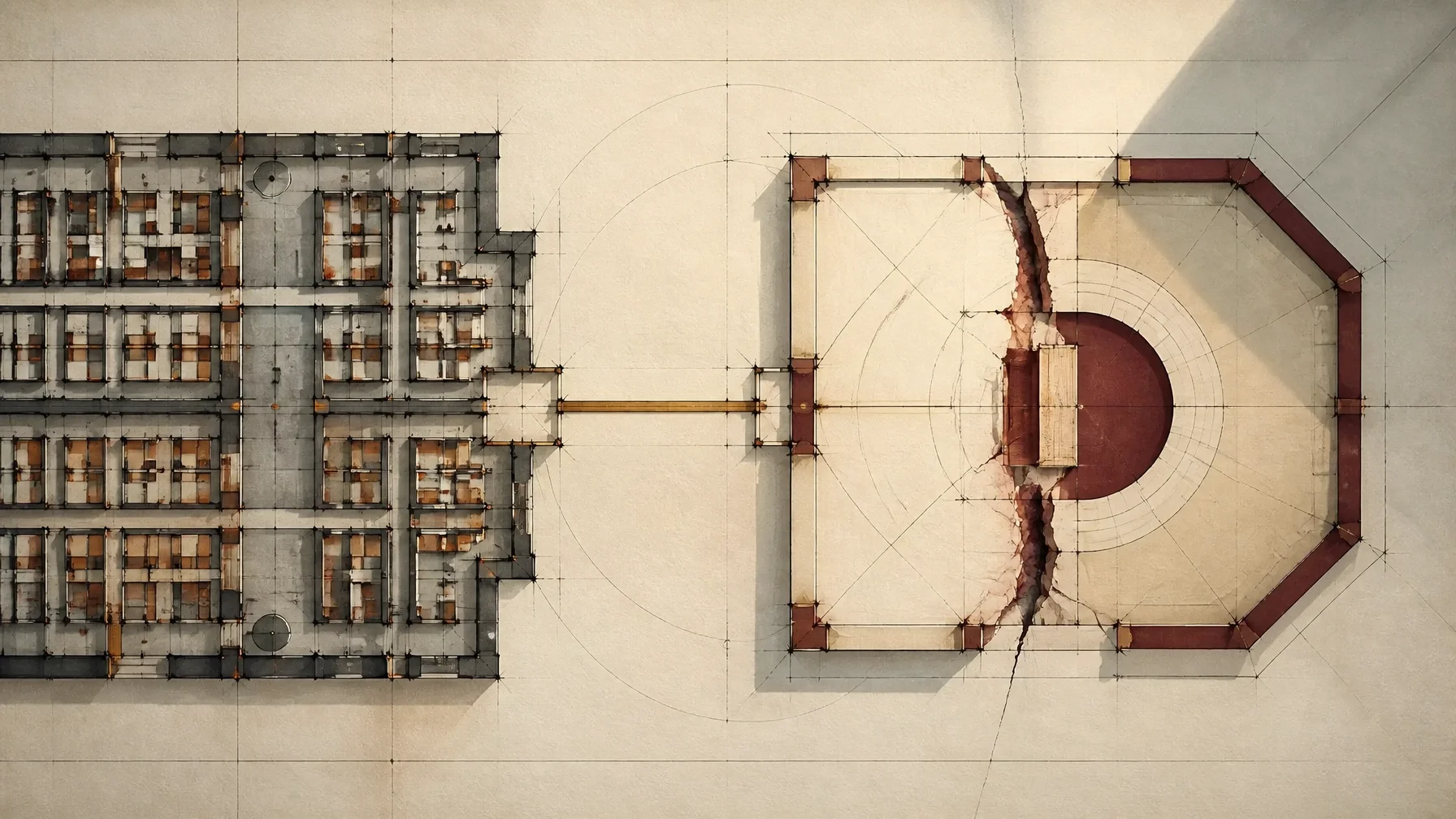
Architectural plan showing a dense gray structure connected to a cracked cream and burgundy structure, representing workload and values conflict.
Individual-level steps
A physician experiencing persistent distress should consider:
Clarifying the dominant pattern
Is the primary experience exhaustion, ethical conflict, depression, anxiety, executive dysfunction, trauma exposure, substance use, or a combination?Obtaining appropriate clinical evaluation
Burnout screening is not a differential diagnosis. A physician or qualified mental health professional can evaluate mood, anxiety, ADHD, sleep, substance use, trauma, and medical contributors.Reducing immediate risk
This may include workload modification, leave, peer support, professional coaching, psychotherapy, medication evaluation, or addiction medicine consultation when indicated.Mapping return conditions
Identify which demands, policies, staffing conditions, or role expectations must change before returning to the same level of responsibility.Building durable behavioral support
Executive decision fatigue, poor recovery, compulsive coping, and chronic overextension require structured intervention rather than general advice.
Institutional-level changes
Organizations should examine:
Staffing adequacy and workload distribution
Documentation and administrative burden
Productivity targets and scheduling density
Physician autonomy and decision latitude
Access to ethics consultation and escalation pathways
Fairness and transparency in policy decisions
Leadership accountability for clinician well-being
Psychological safety after adverse events
Confidential access to treatment and physician health services
Measurement of clinician experience alongside operational outcomes
Durable behavioral transformation requires both levels. The system must become more workable, and the individual must receive clinically appropriate support for the effects of prolonged exposure.
How ART Prevention approaches the distinction
ART Prevention treats physician distress as an interaction among workload, values, recovery capacity, behavioral systems, executive function, environment, and clinical factors. The purpose is not to assign a label based on one symptom. It is to interpret the configuration.
Through physician-led interpretation and behavioral health analytics, the process distinguishes what is being driven by occupational load, what reflects values conflict, what may indicate ADHD-related executive dysfunction, and what requires addiction medicine or mental health care.
This approach is relevant to physicians, medical leaders, executives, founders, and high-functioning professionals managing executive stress, executive burnout symptoms, or executive burnout recovery. It also provides a more precise context for professional stress management, ADHD coaching for professionals, and clinically informed behavioral transformation.
The ART Prevention Framework is not a replacement for organizational reform or psychiatric treatment. It is a structured method for clarifying interacting contributors and prioritizing the next appropriate intervention. Physician-led clinical integration is provided when clinically indicated.
If distress is persistent, impairing, or associated with substance use, suicidal thinking, or concerns about patient safety, seek immediate professional support. In the United States, call or text 988 for the Suicide and Crisis Lifeline, call 911 for an emergency, or contact a physician health program or qualified clinician.
Conclusion
Burnout asks whether chronic occupational stress has depleted capacity.
Moral injury asks what repeated conditions have forced the clinician to violate or abandon deeply held professional commitments.
The answers may overlap, but they are not identical. A break may restore capacity. It cannot, by itself, repair a system that repeatedly produces exhaustion, ethical conflict, or both.
Effective physician burnout solutions are layered. They combine organizational change, clinical evaluation, structured skills, professional support, and an accurate interpretation of the person’s behavioral and environmental context.
For a confidential fit assessment, request an initial consultation. The next step is voluntary and based on your goals, circumstances, and clinical indication.
Sources
[1]: Panagioti M, et al. “Controlled Interventions to Reduce Burnout in Physicians: A Systematic Review and Meta-analysis.” JAMA Internal Medicine. https://doi.org/10.1001/jamainternmed.2016.7674
[2]: West CP, Dyrbye LN, Erwin PJ, Shanafelt TD. “Interventions to Prevent and Reduce Physician Burnout: A Systematic Review and Meta-analysis.” The Lancet. https://doi.org/10.1016/S0140-6736(16)31279-X
[3]: “Burnout and Cognitive Functioning: A Systematic Review and Multivariate Meta-analysis.” Brain and Behavior evidence synthesis. https://pmc.ncbi.nlm.nih.gov/articles/PMC11007411/
[4]: Collett G, et al. “Efficacy of Individual-Level Interventions to Mitigate the Risk for Burnout Among Health Care Professionals.” Annals of Internal Medicine. https://pubmed.ncbi.nlm.nih.gov/41248499/
Dean W, Talbot S, Dean A. “Reframing Clinician Distress: Moral Injury Not Burnout.” Federal Practitioner. https://pmc.ncbi.nlm.nih.gov/articles/PMC6752815/
Shanafelt TD, Noseworthy JH. “Executive Leadership and Physician Well-Being: Nine Organizational Strategies to Promote Engagement and Reduce Burnout.” Mayo Clinic Proceedings. https://pubmed.ncbi.nlm.nih.gov/27871627/
AI-assisted editorial drafts, reviewed and approved by Dr. Bishoy Samuel. All content reflects Dr. Samuel's core clinical expertise and professional experience, and remains within that scope.