High-Functioning Addiction: Why Professionals Hide It Best and How Recovery Starts

Cross-section of a mature tree showing concentric growth rings, a damaged central area, and a living graft reinforcing the structure.
Performance can remain visible while impairment develops elsewhere
“High-functioning addiction” and “high-functioning alcoholism” are colloquial descriptions, not medical diagnoses. They usually refer to a person who continues to meet professional responsibilities while alcohol or drug use is becoming difficult to control.
The term can obscure more than it explains. It suggests that occupational performance is the primary measure of health. It is not.
A physician may continue seeing patients while sleep, judgment, prescribing boundaries, or personal relationships deteriorate. An executive may meet every quarterly target while using alcohol to manage stress, stimulants to extend work hours, or sedatives to force sleep. A founder may remain decisive in public while privately experiencing escalating cravings, secrecy, withdrawal, or compulsive coping behaviors.
Professional competence can delay recognition. It does not rule out a substance use disorder.
The National Institute on Alcohol Abuse and Alcoholism defines alcohol use disorder, or AUD, as an impaired ability to stop or control alcohol use despite social, occupational, or health consequences. AUD exists on a spectrum from mild to severe. The same principle applies to other substance use disorders.
The central clinical question is not, “Can this person still perform?”
It is, “What is the substance use doing to the person’s health, reliability, judgment, relationships, and ability to direct behavior?”
Why addiction in professionals is missed
High-functioning professionals often have several forms of protection that delay intervention:
Performance: strong work output creates reassurance for colleagues and family.
Responsibility: the person may be viewed as indispensable.
Intelligence: explanations become sophisticated enough to sound clinically persuasive.
Status: others hesitate to challenge a physician, executive, attorney, or founder.
Access: alcohol, prescription medications, stimulants, or professional networks may be unusually available.
Compensation: money, staff support, travel flexibility, and delegated responsibilities can conceal consequences.
Secrecy: use may occur outside visible work hours or through carefully controlled routines.
The professional role often becomes part of the concealment system. Meetings are attended. Notes are completed. Patients are seen. Revenue continues. The substance-related impairment may appear first in recovery capacity, family trust, emotional regulation, financial decisions, sexual behavior, sleep, or physical health.
A 2014 analysis in the Canadian Medical Association Journal described how workplace function may be the last domain to deteriorate. It also emphasized that the apparent “functioning” of a person can depend on accommodation by colleagues, family, and institutions. Read the analysis.
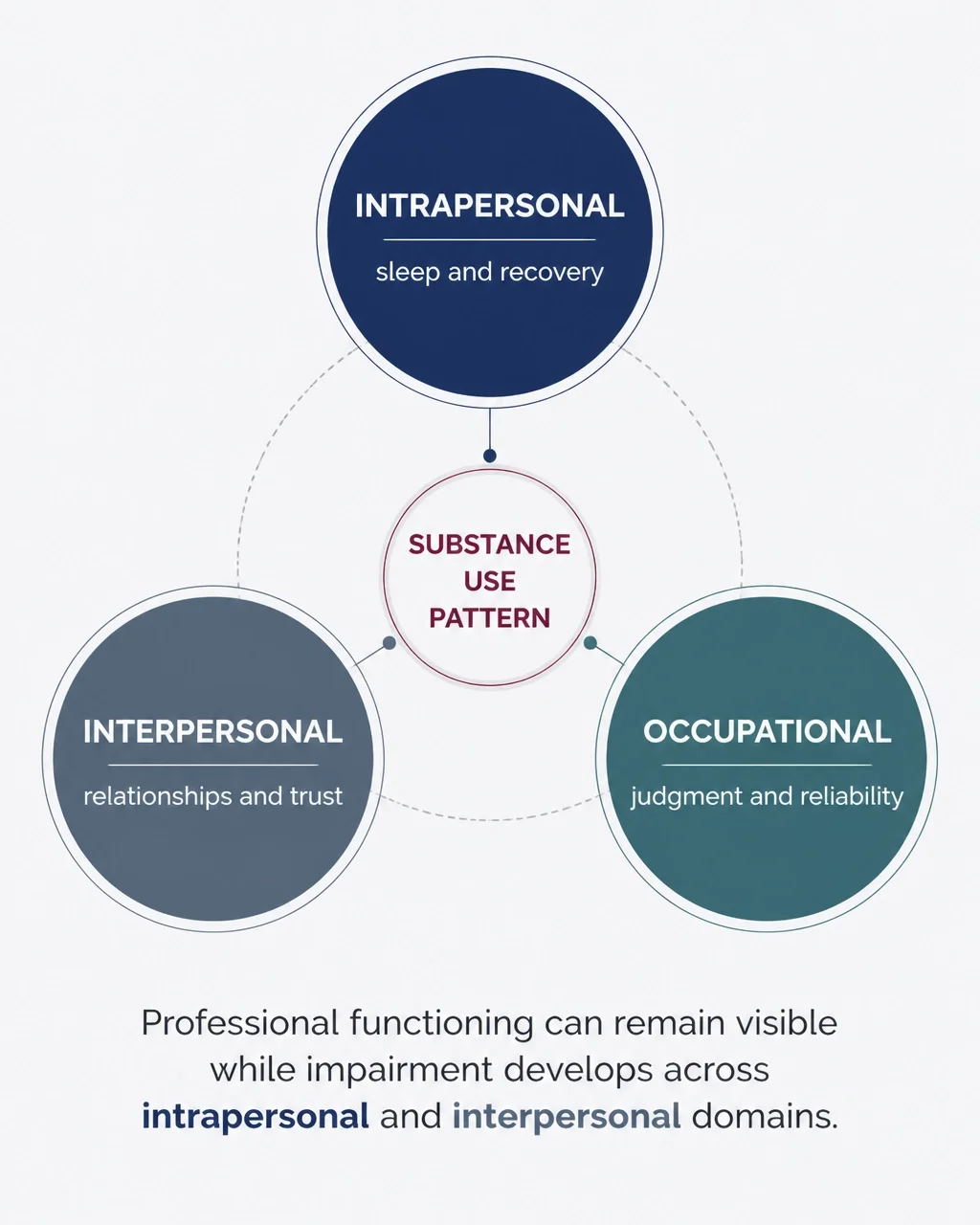
Diagram connecting a central substance use pattern with intrapersonal, interpersonal, and occupational domains.
Risky use, dependence, and substance use disorder are not interchangeable
Accurate language matters because each pattern requires a different clinical response.
Risky or hazardous use
Risky use increases the likelihood of harm because of amount, frequency, speed, context, or situation. Examples include drinking before patient care, driving after drinking, combining alcohol with sedatives, or using stimulants to work through prolonged sleep deprivation.
A person can engage in risky use without meeting criteria for AUD or another substance use disorder.
Harmful use
Harmful use produces physical, psychological, occupational, or relational consequences. The person may recognize the consequences but continue the pattern.
Tolerance
Tolerance means that more of a substance is required to produce the previous effect, or that the same amount produces less effect over time. Tolerance can increase risk but is not, by itself, proof of a substance use disorder.
Physical dependence
Physical dependence occurs when the body adapts to a substance and withdrawal symptoms develop after abrupt reduction or cessation. Physical dependence can occur with prescribed medications and is not identical to addiction.
Substance use disorder
A substance use disorder involves a clinically significant pattern of impaired control, craving, continued use despite harm, hazardous use, or disruption of important activities. Diagnosis requires a qualified clinician to assess the full pattern, duration, severity, and context.
A person does not need to lose a career, receive a legal charge, or experience a public crisis before needing treatment.
Addiction and burnout can overlap without being the same problem
Addiction and burnout frequently appear together in high-pressure professions, but neither should be used to explain the other automatically.
Burnout is an occupational phenomenon associated with chronic workplace stress that has not been successfully managed. It is not itself a medical diagnosis. Addiction is a clinical disorder involving substance-related impairment and loss of control.
A physician experiencing physician burnout symptoms may use alcohol to recover after difficult shifts. An executive experiencing executive decision fatigue may use stimulants to sustain output. These patterns indicate overlap, not causation.
The assessment must examine:
Sleep quantity and quality
Trauma exposure and moral injury
Depression and anxiety
Medical contributors
Medication interactions
Withdrawal risk
Occupational stressors
Safety-sensitive duties
Executive-function demands
Family and relationship changes
Access to substances
Prior treatment and relapse history
The same distinction applies to ADHD and addiction. ADHD does not cause addiction, and not every person with ADHD requires addiction treatment. However, untreated executive-function difficulties, impulsivity, sleep disruption, emotional dysregulation, and chronic under-recovery may complicate assessment and treatment.
The same principle applies to neurodivergence and addiction, giftedness and ADHD, and the experiences of twice exceptional adults or twice exceptional ADHD adults. These identities require differentiated interpretation, not automatic explanations. In high functioning ADHD adults, substance use may be used as an attempted solution for focus, inhibition, sleep, or emotional regulation. That possibility requires careful clinical evaluation rather than an assumption that ADHD is the primary cause.
Why shame delays addiction recovery
Professionals often understand addiction intellectually before they can acknowledge it personally. Shame creates a conflict between identity and evidence:
“I am responsible, so this cannot be a disorder.”
“I understand the risks, so I should be able to stop.”
“My career is intact, so treatment would be excessive.”
“If I disclose this, I will lose my license, authority, or future.”
“I can control it after this deadline.”
These beliefs can maintain secrecy. They also delay addiction medicine for professionals until consequences become more severe.
Stigma is particularly consequential in physician substance use disorder. Physicians may fear licensing consequences, mandatory reporting, damaged reputation, or loss of patient trust. These concerns should be addressed directly with an addiction-informed physician, physician health program, professional advocate, or qualified legal and occupational adviser. Avoiding assessment does not create safety.
Physician health programs can provide evaluation, treatment referral, monitoring, and return-to-practice support when appropriate. Their structure varies by state and circumstance. Evidence from physician monitoring programs indicates that structured treatment and long-term accountability can support recovery and safe professional re-entry, although results from physician populations should not be assumed to apply identically to every professional group.
Recovery begins with a clinical map, not a confession
A useful first step is a private assessment with a clinician experienced in addiction medicine and complex professional populations. The purpose is not to assign a stigmatizing label. It is to establish the pattern accurately.
A comprehensive assessment should determine:
What is being used, how often, and in what context
Whether control has changed over time
Whether tolerance or withdrawal is present
Which domains are affected
Whether there are co-occurring psychiatric or medical conditions
Whether the person performs safety-sensitive work
Which treatment goals are clinically appropriate
Treatment goals may include abstinence, reduced-risk drinking, harm reduction, stabilization, or a staged transition. The appropriate goal depends on the substance, severity, withdrawal risk, medical context, prior history, professional responsibilities, and patient preference. Abstinence and moderation are not interchangeable prescriptions.
Evidence-based treatment is a continuum
Effective addiction treatment is not limited to residential rehabilitation. It may include outpatient care, intensive outpatient treatment, partial hospitalization, residential treatment, mutual support, medication, or physician health program involvement.
Common components include:
Motivational interviewing: resolves ambivalence and strengthens personally meaningful reasons for change.
Cognitive behavioral therapy: identifies triggers, beliefs, routines, and reinforcement patterns that sustain use.
Structured skills training: builds alternatives for stress, sleep, emotional regulation, communication, and decision-making.
Mutual support: provides accountability and social connection beyond clinical sessions.
Medication treatment: supports specific recovery goals when clinically indicated.
Relapse prevention: anticipates high-risk transitions, detects early warning signs, and defines a response plan.
The 2023 AHRQ comparative effectiveness review and its companion JAMA analysis examined 118 randomized trials involving more than 20,000 adults with AUD. Oral naltrexone and acamprosate had the strongest evidence among medications reviewed and are commonly considered first-line options, alongside psychosocial treatment, when clinically appropriate. AHRQ summary and JAMA review.
A network meta-analysis by Bahji and colleagues reviewed 156 trials involving 27,334 participants. It found evidence for several medications, including acamprosate, oral naltrexone, and disulfiram, while also documenting variation in study quality, treatment goals, and clinical populations. Read the systematic review.
Medication selection is individualized. Naltrexone may be unsuitable for a person using opioids or requiring opioid analgesia. Acamprosate requires attention to kidney function and adherence. No medication treats every form of AUD, and medications for AUD do not replace acute withdrawal management.
Abrupt cessation of heavy alcohol use can cause severe withdrawal, including seizures or delirium. Opioid and benzodiazepine withdrawal can also require urgent or medically supervised care. Do not attempt unsupervised detoxification when dependence or withdrawal risk is possible.
How ART Prevention interprets the pattern
ART Prevention approaches high-functioning addiction as an interaction among substance use, values, recovery capacity, behavioral systems, occupational demands, executive function, and medical or psychiatric factors.
The objective is not to collect a list of symptoms. It is to identify how the system operates:
Where does use provide short-term relief?
Which costs remain hidden?
Which values are being protected or compromised?
What conditions increase risk?
Which intervention has the highest clinical and behavioral yield?
What structure is required to sustain change after initial motivation declines?
Physician-led interpretation helps distinguish addiction from burnout, ADHD-related impairment, depression, anxiety, trauma, medication effects, and ordinary professional strain. It also identifies where clinical care, behavioral transformation, occupational safeguards, and recovery support must be integrated.
The output is a sequenced path forward, not generic advice.
When urgent help is necessary
Seek emergency help immediately for suspected overdose, severe alcohol withdrawal, seizures, delirium, respiratory depression, suicidal intent, or an immediate risk to patients, clients, colleagues, or the public.
In the United States, SAMHSA’s National Helpline provides free, confidential, 24/7 treatment information and referrals at 1-800-662-HELP (4357). In an immediate emergency, call 911 or go to the nearest emergency department.
For a private discussion about whether physician-led behavioral and clinical assessment is appropriate, request a consultation with ART Prevention. The purpose is fit assessment. No treatment decision is made without appropriate clinical evaluation.
Sources
Bahji et al., Pharmacotherapies for Adults With Alcohol Use Disorders
Glauser, “High-functioning addicts”: intervening before trouble hits
AI-assisted editorial drafts, reviewed and approved by Dr. Bishoy Samuel. All content reflects Dr. Samuel's core clinical expertise and professional experience, and remains within that scope.