Burnout and ADHD: Why High-Functioning Professionals May Feel Like They’re Failing

Mechanical balance scale with stacked bronze, terracotta, ivory, and teal weights on one side and a small amber vial on the other.
A professional can remain successful while becoming progressively less sustainable.
They may continue leading teams, treating patients, meeting deadlines, or building a company while relying on longer hours, urgency, over-preparation, and intense self-monitoring to maintain the same level of performance. The external result remains visible. The internal cost is not.
This pattern is common in high functioning ADHD adults, executives, founders, physicians, and other professionals whose strengths have supported years of compensation.
The central issue is not a lack of discipline. It is the interaction between ADHD-related executive-function demands, chronic occupational stress, recovery capacity, and the conditions in which performance is being produced.
Burnout and ADHD overlap, but they are not interchangeable
Burnout is defined by the World Health Organization as an occupational phenomenon resulting from chronic workplace stress that has not been successfully managed. It is characterized by:
Energy depletion or exhaustion
Increased mental distance, cynicism, or negativism toward work
Reduced professional efficacy
Burnout is not itself a medical diagnosis or mental disorder under ICD-11.
ADHD is a neurodevelopmental condition involving persistent symptoms of inattention and/or hyperactivity-impulsivity that begin during development, affect functioning, and occur across relevant settings. Executive-function difficulties may include problems with planning, time management, organization, working memory, self-motivation, emotional regulation, and task completion.
The overlap is real. Both can involve:
Difficulty concentrating
Disorganization
Time-management problems
Irritability
Reduced follow-through
Emotional overload
Executive decision fatigue
The mechanisms are not identical.
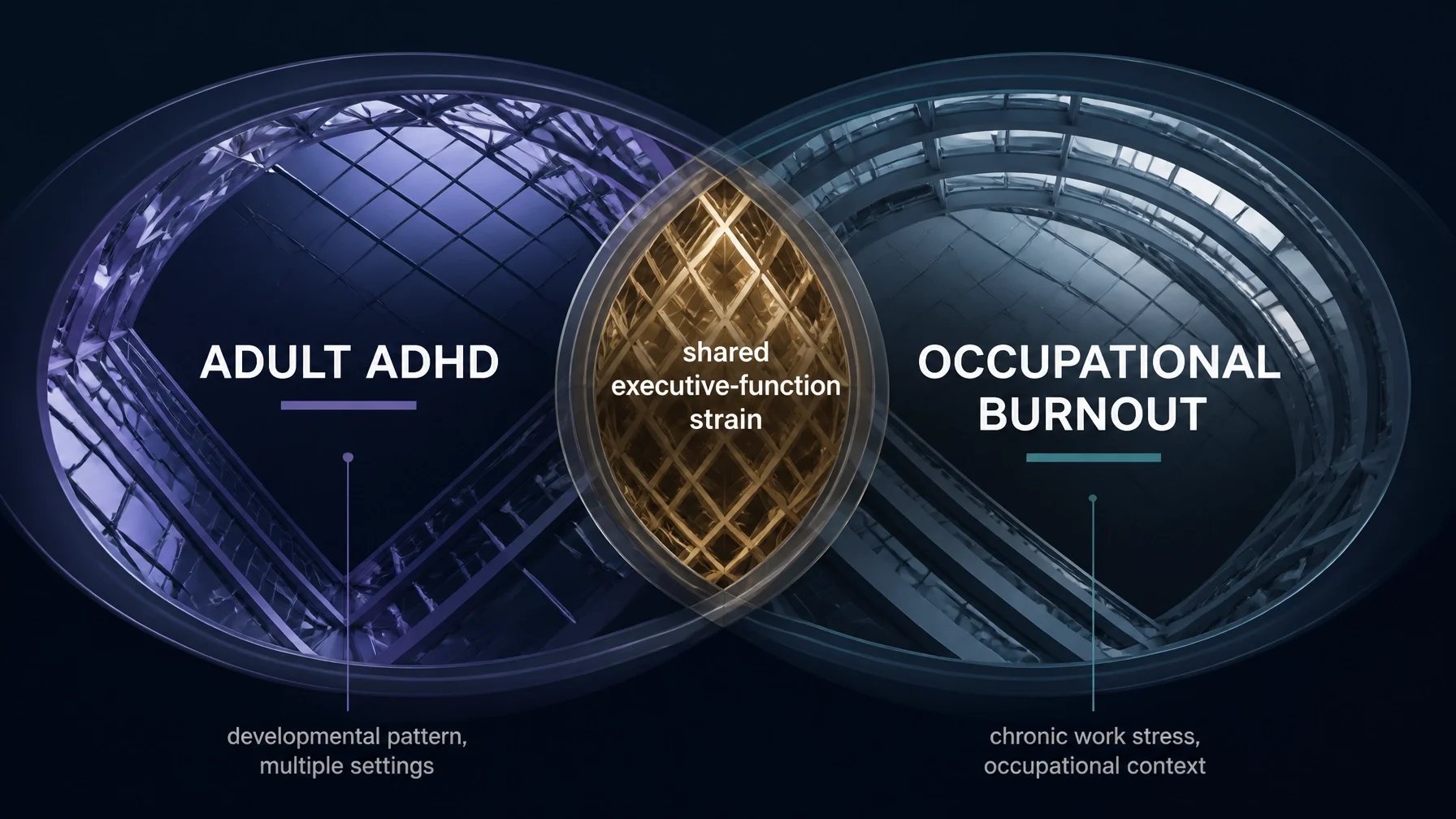
Overlapping architectural forms compare adult ADHD and occupational burnout, with shared executive-function strain shown at the center.
A new decline in concentration after months of excessive workload may reflect burnout, sleep disruption, depression, anxiety, a medical condition, or another stress-related process. A lifelong pattern of inconsistent attention, time blindness, disorganization, or task initiation difficulty across work and personal life may warrant evaluation for ADHD.
Both processes can also exist together. This is the clinical importance of burnout and ADHD. ADHD can increase the executive cost of work. Burnout can then further impair attention, planning, motivation, and emotional regulation.
One condition can amplify the functional effects of the other.
Compensation can conceal impairment
High performance is not proof that the underlying system is stable.
Professionals with ADHD may compensate through:
Working late to complete tasks that were difficult to initiate
Using urgency or crisis pressure to activate attention
Over-preparing for meetings and presentations
Rechecking work repeatedly
Relying on memory, willpower, or excessive digital reminders
Avoiding delegation because oversight feels more demanding than completion
Masking confusion, missed details, or inconsistent follow-through
Selecting roles that provide stimulation while avoiding routine administrative demands
These strategies can be effective for a period of time. They also consume capacity.
When recovery is adequate, compensation may remain manageable. Under prolonged workload, role ambiguity, conflict, sleep disruption, or value misalignment, the same strategies become expensive. The professional continues to function, but the margin for error narrows.
Common executive burnout symptoms include:
Persistent exhaustion that sleep does not fully resolve
Slower processing and reduced cognitive flexibility
Difficulty prioritizing routine decisions
Increased sensitivity to interruptions and ambiguity
Loss of professional meaning
Irritability or emotional withdrawal
More frequent errors and unfinished tasks
Increasing dependence on urgency, stimulants, alcohol, or compulsive work
The relevant question is not only whether performance has declined. It is whether performance now requires substantially more effort to maintain.
Executive function is one pathway between ADHD and burnout
A 2024 study by Turjeman-Levi, Itzchakov, and Engel-Yeger examined 171 employees and found that executive-function deficits mediated the relationship between ADHD symptoms and job burnout.
The most important pathways involved:
Self-management to time, including planning and prioritizing
Self-organization and problem-solving, including structuring tasks and responding to demands
The study linked time-management difficulties more strongly with physical fatigue. Self-organization and problem-solving difficulties were more closely associated with emotional exhaustion and cognitive weariness. The authors also identified higher burnout and executive-function difficulties among participants screening positive for ADHD.
This study has limitations. It relied on self-report, used a modest sample, and was not a longitudinal clinical trial. It does not establish that every adult with ADHD will develop burnout.
It does clarify an important mechanism. Ordinary professional tasks can require more executive effort when time, organization, initiation, and prioritization are persistently difficult. Under sustained pressure, that extra effort can become a major contributor to exhaustion.
Arnsten’s review of stress signaling and the prefrontal cortex provides a complementary neurobiological explanation. High stress can disrupt prefrontal networks involved in working memory, attention regulation, and cognitive control. For a professional already managing ADHD-related executive demands, chronic stress may further reduce the capacity needed for planning and flexible decision-making.
This is not evidence that stress permanently damages every person’s cognition. It is evidence that stress and executive function interact.
The workplace often contributes more than the individual
Burnout prevention cannot be reduced to personal resilience.
Physicians, executives, and senior professionals may face:
Unmanageable workload
Low control over critical decisions
Role ambiguity
Administrative inefficiency
Insufficient staffing
Conflicting performance demands
Inadequate leadership support
Ethical or values-based conflict
Continuous communication and decision volume
These conditions matter for everyone. They may be especially consequential for professionals whose executive systems are already carrying a high compensation load.
The evidence supports a systems-level response. In a systematic review and meta-analysis published in JAMA Internal Medicine, Panagioti and colleagues found that organization-directed interventions had a larger effect on physician burnout than physician-directed interventions. The standardized mean difference was −0.45 for organization-directed interventions compared with −0.18 for physician-directed interventions.
West and colleagues, writing in The Lancet, found that both individual-focused and structural interventions produced meaningful reductions in physician burnout. Their findings do not make individual treatment irrelevant. They establish that individual and organizational interventions should be combined.
The conclusion is direct:
> Individual skills matter. They cannot compensate indefinitely for an unsustainable system.
Organizational physician burnout solutions may include workload redesign, improved staffing, reduced clerical burden, clearer decision rights, better team structures, and meaningful participation in operational decisions. Shanafelt and Noseworthy identify leadership, efficiency, community, flexibility, values alignment, and sustained organizational attention as central strategies for physician well-being.
Managing executive stress therefore requires more than personal routines. It requires examining whether responsibility, authority, resources, and values are aligned.
Giftedness and twice-exceptionality require differentiated interpretation
The experience of giftedness and ADHD is frequently described through the term twice exceptionality. Twice exceptional adults and twice exceptional ADHD adults may show very high ability in some areas alongside significant difficulty with organization, processing speed, emotional regulation, or task completion.
High ability can conceal impairment. Strong verbal reasoning, professional expertise, or intense interest may allow a person to compensate for years. It can also lead colleagues and clinicians to underestimate the support required.
The evidence base remains limited. Adult research on twice exceptionality is smaller and less consistent than the broader ADHD literature. Current evidence does not support a single, reliable “2e profile,” nor does it justify assuming that giftedness causes burnout or changes ADHD into a separate condition.
A careful assessment should examine:
Developmental history
Symptoms across settings
Functional impairment
Relative strengths and weaknesses
Sleep, mood, anxiety, and medical factors
Environmental demands
The cumulative cost of compensation
The appropriate clinical question is not whether a person is gifted enough to have ADHD. It is how the individual’s strengths and vulnerabilities interact in the environments where functioning is required.
Moral injury and compulsive coping require clinical precision
Burnout is not identical to moral injury. Moral injury burnout is often used to describe the overlap between exhaustion and repeated violations of deeply held professional values. A physician who cannot provide appropriate care because of staffing, administrative, or institutional constraints may be experiencing more than workload strain.
Organizational accountability is required when the primary problem is repeated ethical conflict.
Individual evaluation is also important when chronic stress has affected sleep, mood, executive function, or coping. Compulsive coping behaviors may include excessive work, alcohol, stimulants, gambling, sexual behavior, food, or digital stimulation.
This is where addiction and burnout can become clinically connected. Burnout may increase reliance on substances or other behaviors for energy, relief, focus, or emotional regulation. ADHD may also increase vulnerability to impulsive or reward-seeking patterns. The combined phrase ADHD and addiction should not be used to assume causation, but the interaction deserves assessment when substance use is escalating or difficult to control.
Terms such as high functioning addiction and high functioning alcoholism are colloquial, not diagnoses. Continued professional performance does not exclude a substance use disorder. This is relevant to addiction in professionals, including physician substance use disorder, where access, secrecy, stigma, and professional identity can delay care.
Addiction medicine for professionals requires individualized risk assessment, confidentiality within applicable legal limits, treatment of co-occurring conditions, and attention to professional responsibilities. Addiction recovery and addiction relapse prevention are ongoing clinical processes, not tests of character. Any treatment plan must be based on diagnosis, severity, safety, and clinical indication.
What can help, and where the limits are
CBT and structured skills training have meaningful evidence for adult ADHD. These approaches can target:
Time management
Organization
Task initiation
Cognitive restructuring
Emotional regulation
Problem-solving
Follow-through
Professional coaching can also support implementation, accountability, delegation, and role design. ADHD coaching for professionals may be useful when it is specific, structured, and integrated with appropriate clinical care. Its evidence base is more limited than the evidence for CBT, and coaching does not replace medical evaluation or psychotherapy when those are indicated.
Useful workplace supports may include:
Written priorities and explicit deadlines
Smaller project milestones
Reduced context switching
Structured check-ins
Externalized reminders and task systems
Protected focus periods
Flexible scheduling when appropriate
Clearer delegation and escalation pathways
These interventions can reduce executive friction. They cannot make an unsustainable workload sustainable indefinitely.
How ART Prevention interprets the pattern
ART Prevention approaches burnout as an interaction among values, recovery capacity, behavioral systems, environmental demands, executive function, and relevant clinical factors.
Its purpose is not simply to label stress or confirm a diagnosis. Physician-led interpretation examines how the pattern operates across the person’s life and identifies where change has the greatest leverage.
This is where behavioral health analytics can support behavioral transformation. Structured information helps distinguish a recovery problem from a workload problem, an executive-function problem from a mood problem, or a values conflict from a simple time-management deficit.
The ART™ Framework maps these relationships and translates them into a personalized path forward. Dr. Bishoy Samuel, a dual board-certified physician in preventive and addiction medicine, interprets the behavioral profile alongside clinically relevant factors when indicated.
The process is individualized. The clinical boundaries remain clear.
Burnout symptoms can overlap with ADHD, depression, anxiety, sleep disorders, substance use disorders, medication effects, and medical conditions. A structured article cannot diagnose the cause of an individual’s symptoms.
A complimentary 30-minute consultation with Dr. Samuel determines whether ART Prevention is appropriate for your goals and circumstances. It is a fit assessment, not an obligation to continue.
The objective is not to prove that you are failing.
It is to identify what your current system is requiring from you, what that requirement is costing, and what can be changed.
Sources and further reading
World Health Organization: Burn-out as an occupational phenomenon
Panagioti et al.: Controlled Interventions to Reduce Burnout in Physicians, JAMA Internal Medicine
West et al.: Interventions to Prevent and Reduce Physician Burnout, The Lancet
Arnsten: Stress Signaling Pathways That Impair Prefrontal Cortex Structure and Function
Shanafelt and Noseworthy: Executive Leadership and Physician Well-being
Dean et al.: Reframing Clinician Distress, Moral Injury Not Burnout
National Institute on Drug Abuse: Drugs, Brains, and Behavior, The Science of Addiction
This article provides general educational information and does not replace individualized medical evaluation, diagnosis, or treatment. Burnout is not itself a medical diagnosis. Physician-led services, including ADHD, addiction medicine, and medical evaluation, are provided by consultation and based on clinical indication. If substance use creates an immediate safety risk, seek urgent medical assistance.
AI-assisted editorial drafts, reviewed and approved by Dr. Bishoy Samuel. All content reflects Dr. Samuel's core clinical expertise and professional experience, and remains within that scope.