Burnout Doesn’t Announce Itself: How High Achievers Miss the Warning Signs

Physician standing in a modern clinical corridor with a focused expression and people visible in the distance.
A high-functioning professional can continue leading meetings, treating patients, making decisions, and meeting deadlines while the underlying capacity to recover is steadily declining.
This is why burnout often goes unrecognized in executives, founders, physicians, and senior leaders. The visible output remains intact. The hidden system is deteriorating.
Dedication becomes the disguise.
Performance can remain stable while recovery collapses
Early burnout rarely begins with an obvious breakdown. It often appears as a subtle change in the relationship between effort and recovery:
Sleep no longer restores energy.
Routine decisions require disproportionate effort.
Work expands into evenings and weekends without a clear increase in output.
Patience becomes less available.
Previously meaningful work feels procedural or emotionally distant.
Time away provides temporary relief, but the same exhaustion returns quickly.
These are common executive burnout symptoms, but they are often interpreted as evidence of responsibility. A leader may call persistent fatigue “a demanding quarter.” A physician may describe emotional detachment as professionalism. A founder may treat constant overcommitment as the cost of building something important.
The problem is not ambition. The problem is that performance compensation can conceal declining recovery capacity.
A person may still be functioning at a high level because they are using more effort, more hours, more control, and more self-suppression to produce the same result. The output is visible. The cost is not.
Why burnout does not announce itself
Burnout develops through interaction between demands, resources, values, behavior, and environment. It is not simply a failure of resilience.
The World Health Organization classifies burnout as an occupational phenomenon resulting from chronic workplace stress that has not been successfully managed. It is characterized by exhaustion, increased mental distance or cynicism toward work, and reduced professional efficacy. It is not classified as a medical condition or mental disorder in ICD-11. WHO definition of burnout
For high achievers, several mechanisms delay recognition:
Compensation
You increase effort when capacity falls. More preparation, longer hours, tighter control, and greater reliance on urgency preserve performance temporarily.Normalization
Chronic stress becomes familiar. What began as an exception becomes the standard operating condition.Identity fusion
When professional output is closely tied to identity, slowing down can feel like a threat to competence, status, or purpose.External reinforcement
Organizations often reward reliability without measuring the cost of maintaining it. Continued performance can conceal an unsustainable system.Delayed feedback
Recovery capacity declines gradually. The consequences may become obvious only after sleep, concentration, relationships, and judgment have already changed.
Burnout prevention therefore depends on detecting changes before collapse, not waiting for incapacity to make the problem visible.
The three-domain framework for early warning signs
A useful early-warning structure examines burnout across intrapersonal, interpersonal, and occupational domains. The domains overlap, but each reveals a different part of the configuration.
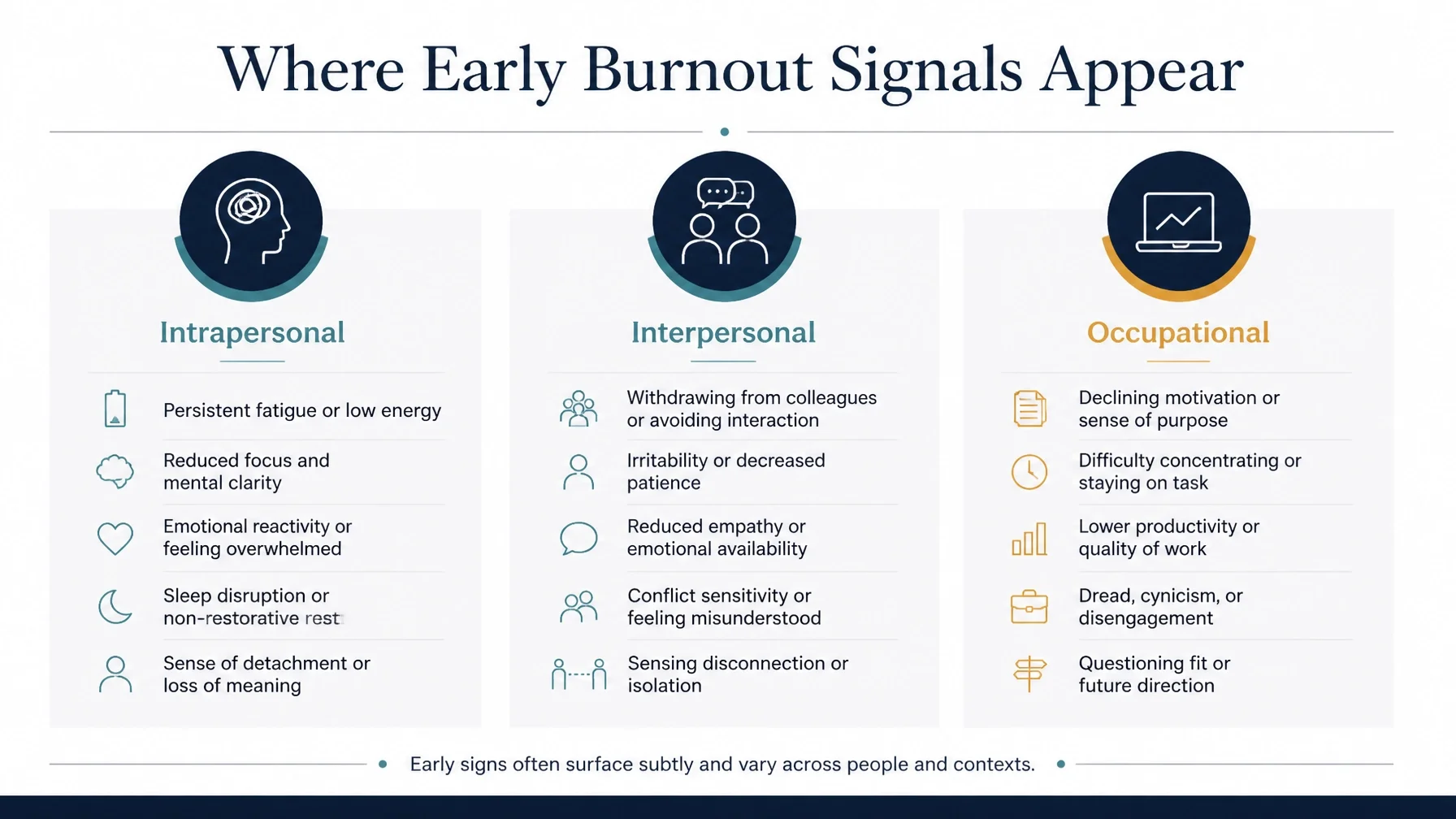
Architectural diagram showing three connected domains representing internal experience, relationships, and occupational functioning.
1. Intrapersonal signs: the internal system is under load
This domain includes energy, sleep, cognition, mood, and physical functioning.
Relevant signs include:
Fatigue that persists after weekends or routine time away
Difficulty falling asleep, early waking, or racing thoughts
Reduced concentration and working memory
Slower processing of information
Increased reliance on stimulants, urgency, or last-minute pressure
Headaches, muscle tension, gastrointestinal symptoms, or frequent minor illness
Lower tolerance for ordinary demands
Loss of interest in activities that previously restored capacity
Executive decision fatigue is particularly important. You may still make complex decisions, but simple choices begin to consume unusual mental energy. Re-reading messages, postponing routine approvals, or avoiding low-stakes decisions can signal cognitive weariness rather than poor discipline.
2. Interpersonal signs: connection becomes more expensive
Burnout changes how people relate to colleagues, patients, clients, family members, and direct reports.
Watch for:
Irritability or a shorter emotional fuse
Reduced empathy or patience
Cynicism toward colleagues, patients, customers, or the organization
Social withdrawal
Treating people primarily as demands, problems, or interruptions
More conflict over issues that previously felt manageable
A persistent sense that others are consuming limited capacity
For physicians, reduced empathy may be labeled “depersonalization.” For executives, it may appear as detachment from the team. In either case, the change is clinically and organizationally relevant. It can affect judgment, collaboration, patient care, and retention before performance metrics show a clear decline.
3. Occupational signs: output is maintained through overextension
Occupational warning signs include:
Working longer while accomplishing less
Difficulty delegating
Repeatedly accepting commitments that exceed available capacity
Reduced creativity or strategic clarity
More avoidable errors and missed details
Avoidance of difficult conversations
Increased absenteeism or presenteeism
Fantasies of escape, resignation, or abandoning the role
Continuing to function only through urgency
A high-functioning professional may not look impaired. The more useful question is whether the current level of performance requires an increasing amount of effort to sustain.
Burnout, moral injury, and values conflict
Burnout is not identical to moral injury.
Burnout commonly centers on exhaustion, mental distance, and reduced efficacy in response to chronic occupational stress. Moral injury involves a deeper disruption of conscience, identity, or professional values after a person perpetrates, witnesses, or is unable to prevent an act that violates deeply held moral beliefs.
This distinction matters in medicine and other high-stakes professions. A physician may know what care a patient needs but be unable to provide it because of staffing constraints, administrative rules, financial barriers, or institutional policy. The resulting distress is not adequately explained by workload alone.
The language of moral injury burnout is increasingly used to describe the overlap, but the constructs should remain distinct. Burnout-focused support cannot substitute for organizational accountability when the primary problem is repeated values violation.
The response must address both layers:
Organizational correction when workload, staffing, workflow, control, or ethical constraints are driving harm
Individual clinical and behavioral support when recovery capacity, coping patterns, executive function, sleep, mood, or substance use have also been affected
This is also relevant to addiction and burnout. Some professionals increase alcohol, stimulants, compulsive work, gambling, sexual behavior, food, or digital stimulation to regulate depletion. These may become compulsive coping behaviors rather than deliberate choices.
Terms such as high functioning addiction and high functioning alcoholism are colloquial, not clinical diagnoses. A person can continue to perform professionally while developing a substance use disorder. This includes addiction in professionals and physician substance use disorder, where secrecy, access, stigma, and professional identity can delay evaluation. Addiction medicine for professionals requires careful risk assessment, confidentiality, and appropriate clinical judgment. It is not a matter of willpower.
Burnout and ADHD can overlap without being the same
Burnout and executive-function impairment share several features:
Poor concentration
Disorganization
Time-management difficulties
Irritability
Emotional overload
Reduced follow-through
Decision paralysis
They are not interchangeable.
ADHD is a neurodevelopmental condition involving persistent patterns that typically begin earlier in life and affect more than one setting. Burnout is a state associated with sustained stress and depleted resources in a particular context. Executive dysfunction can occur with ADHD, burnout, depression, anxiety, sleep disruption, medical conditions, or other forms of neurodivergence.

Architectural pathway moving from a tangled, compressed structure toward a clear illuminated route.
A 2024 field study of 171 employees found that executive-function deficits helped explain the relationship between ADHD symptoms and job burnout. The most important pathways involved self-management of time and self-organization/problem-solving. Study in AIMS Public Health
This helps explain why burnout and ADHD can become mutually reinforcing. ADHD-related executive demands may increase occupational strain. Burnout may then further impair concentration, planning, and emotional regulation.
The same behavioral toolkit can support both conditions:
Cognitive-behavioral strategies
Structured skills training
External time systems
Task sequencing
Workload redesign
Coaching focused on implementation
Sleep and recovery protection
This does not mean that every adult with burnout has ADHD, or that every difficulty in high-functioning ADHD adults is burnout.
The distinction requires history and context. Lifelong, cross-setting patterns warrant individualized assessment. New or sharply worsened impairment linked to sustained occupational stress points toward a state-related process.
The same principle applies to giftedness and ADHD, twice exceptional adults, and twice exceptional ADHD adults. High cognitive ability can support substantial compensation, but giftedness research should not be overstated or used to infer a diagnosis. A sophisticated clinical interpretation examines the full behavioral pattern rather than assigning a label from performance alone.
What the evidence says about recovery
Effective executive burnout recovery does not rely on individual effort alone.
A 2017 meta-analysis in JAMA Internal Medicine found that interventions reduced physician burnout overall. Organization-directed interventions had a larger effect than physician-directed interventions, with standardized mean differences of −0.45 compared with −0.18. Panagioti et al.
A related Lancet systematic review and meta-analysis found that both individual-focused and structural interventions produced meaningful reductions in physician burnout. Overall burnout decreased from 54% to 44% across the included intervention literature. West et al.
The implication is direct:
> Individual skills matter. They cannot compensate indefinitely for an unsustainable system.
Organizational action may include:
Reducing workload and administrative burden
Improving staffing and workflow
Increasing autonomy and role clarity
Correcting dysfunctional scheduling
Creating mechanisms for ethical escalation
Protecting meaningful recovery time
Individual support may include:
CBT-informed stress management
Structured executive-function training
Professional coaching
Communication and boundary skills
Clinical assessment of sleep, mood, ADHD, substance use, or other contributing conditions
Addiction recovery planning and addiction relapse prevention when clinically indicated
This layered approach is the foundation of durable professional stress management. It moves beyond temporary relief toward measurable behavioral transformation.
How ART Prevention interprets the pattern
ART Prevention treats burnout as a configuration problem involving interacting values, recovery capacity, behavioral systems, environmental load, executive function, and relevant clinical barriers.
The purpose of assessment is not simply to identify whether you feel stressed. It is to map how these factors interact and determine where the system is losing stability.
The ART™ Framework approaches burnout as a structured pattern rather than a single symptom. It identifies where visible performance is being maintained through unsustainable compensation and where recovery, behavior, environment, or clinically relevant factors are driving the strain.
Physician-led interpretation translates the identified pattern into prioritized action. That may involve behavioral restructuring, neurodivergence-informed support, medical evaluation, addiction medicine, or a combination of these layers.
The framework is standardized. The interpretation is individualized.
What to do when the signs are present
Begin with observation rather than self-judgment.
Review the last several weeks across three questions:
Intrapersonal: Is recovery restoring you?
Interpersonal: Has your patience or empathy changed?
Occupational: Are you sustaining output through increasing effort?
If signs persist across more than one domain, consider a structured evaluation rather than relying on memory or intuition. Burnout symptoms can overlap with depression, anxiety, sleep disorders, ADHD, substance use, and medical conditions. A qualified clinician can help determine what requires further assessment.
ART Prevention offers a complimentary 30-minute consultation with Dr. Bishoy Samuel to determine whether the framework is appropriate for your goals and circumstances. The consultation is a fit assessment, not an obligation to continue.
The warning signs are often present before performance changes.
The next step is to identify them while the system can still be changed.
Sources and further reading
World Health Organization: Burn-out as an occupational phenomenon
Panagioti et al., “Controlled Interventions to Reduce Burnout in Physicians,” JAMA Internal Medicine
West et al., “Interventions to Prevent and Reduce Physician Burnout,” The Lancet
Dean et al., “Reframing Clinician Distress: Moral Injury Not Burnout”
AI-assisted editorial drafts, reviewed and approved by Dr. Bishoy Samuel. All content reflects Dr. Samuel's core clinical expertise and professional experience, and remains within that scope.